































INTERNATIONAL SCENE
Hungry Sharks Dance Company
The urban dance company, Hungry Sharks, in Austria was established by choreographer Valentin Alfery and producer Dušana Baltić in 2011. Expanding to nineteen team members, Hungry Sharks Dance Company aims to establish the movement vocabulary of urban dance styles in theatre, dedicated to inspiration and experimentation. The company regularly presents feature-length urban dance pieces in Austria, and has traveled to the UK, Germany, Spain, Croatia, Romania, Italy and Turkey.
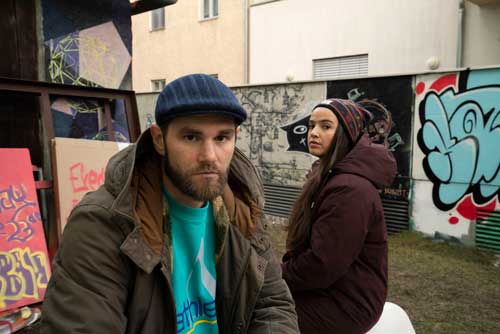
Valentin Alfery and Dušana Baltić, (photo: © Leon Bernhofer)
Valentin Alfery, Artistic Director and Choreographer of Hungry Sharks discovered his passion for urban dance in 2004, when he attended workshops at ImpulsTanz. In the same year he started acting with the theater group, Daskunst, led by Director Asli Kislal, and experienced acting on stage. Alfery’s creativity and ideas began to shape the productions he was involved, as his artistic activities as a dancer and choreographer grew in Vienna, Salzburg and Klagenfur, and internationally.
Within five years, he produced his first solo piece, “Falling,” performing fourteen performances across Austria. He joined the Salzburg group, M.O.T., which successfully competes within the international ‘battle’ Hiphop scene. A year after he founded the Hungry Sharks Company r with producer Dusana Baltic, they created their first international street art project called StreetlifeMAD with more than 20 artists from all over the world.
Alfrey was also cast in the production “The Magic Flute” with the Bregenzer Festspiele during 2013 and 2014, gaining experience as a puppeteer with Mark Down of London’s Blind Summit Puppet Company. He’s created five feature-length productions with Hungry Sharks, tour internationally, and since 2017, he is the project leader and curator of the annual outdoor program “Kulturscheine” in Salburg, featuring street artists, performing arts, music and circus acts.
Dušana Baltić, Production and Tour Manager for Hungry Sharks, which she co-founded with choreographer and Artistic Director, Valentin Alfery, created her first large-scale project during 2011-2012, called “StreetlifeMAD.” Baltić won the GTT Memorial Award for ‘Projects of Exceptional Passion,’ and in 2019, she received an award for performing arts of “Land Kärnten” for the work with Hungry Sharks. For the past two years, she has worked as a freelance curator for “Kulturschiene,”and also manages international relations and production management for Dagmar Dachauer, Frantics Dance Company and Katharina Senk.
Hungry Sharks’ newest work, “Zeitgeist” is an underwater urban dance piece, exploring the potential of temporary states, asking: “How do we discover unused space and adapt to it? How do we use emerging conditions and when do we move on?”
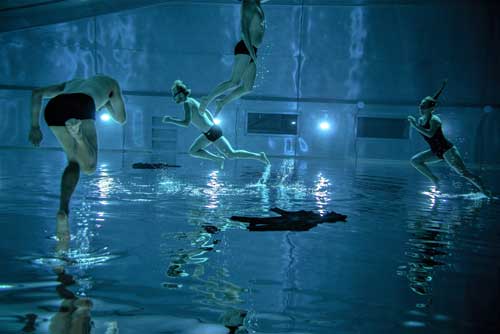
“Zeitgeist” 2019, (photo: © Jelena Jankovic Photography) with Marco Payer, Alex Loftx Tesch, Ragnar Lodbrodski, and Joana Hormann.
From a series of pop-up performances by six dancers, “Zeitgesit” is a continuous body of work that the audience views through glass windows, in which Hungry Sharks sees itself as a reflection of the trend towards temporary use of spaces. One major focal point of the piece is the fundamental exploration of dance and choreography under water, which could be perceived as pioneering work, suspending gravity and by the dancers holding their breath holding their breath under the water.
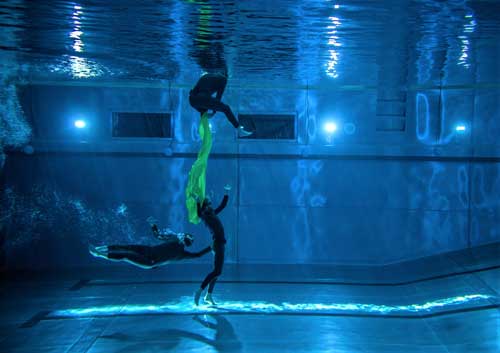
“Zeitgeist” 2019, (photo: © Jelena Jankovic Photography)
Hungry Sharks’ work also includes: “the Sky above, the Mud Below” – a tour de force performance by hip-hop dancer Farah Deen which I experienced at the Colombo International Theatre Festival in Sri Lanka, in which she ventures into a theatrical context through urban dance on a journey through the fields of religion and femininity. During her one-hour solo piece, she challenges a dominating worldview that defines a male figure as the human norm: the Vitruvian Man. What if Leonardo da Vinci had chosen a woman to depict idealised proportions? The themes chosen and the development of this piece are based on elements from the soloist’s autobiography. Through the spectrum of her personal experience, she examines polarizing social categories and sheds a light on their boundaries and grey areas.
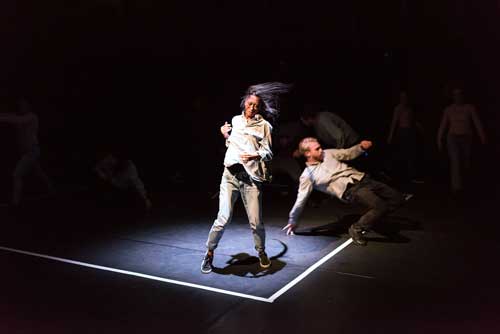
“Hidden in Plain Sight,” (photo: (© Erli Gruenzweil)
Other work by Hungry Sharks includes “Hidden in Plain Sight,” “Anthropozan,” #fomo – the fear of missing out,” and “StreetlifeMAD” most recent work of dance company.
Hungry Sharks has incorporated urban dance styles derived from ‘Breaking,’ ‘Locking,’ ‘Popping,’ ‘Hip Hop Freestyle,’ ‘House Dance,’ and ‘Krumping’ to existing formats of contemporary stage performance, developing a coherent stylistic means and narrative language, choreography and concepts that will speak to the audience. Their pieces are a combination of virtuoso and dance-dominated sequences, against strong screen images.
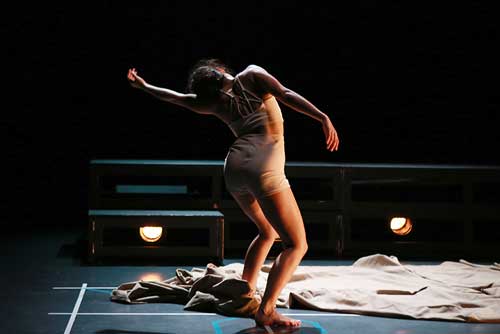
When I had the pleasure of performing my solo play and teaching my Master Workshop at the 2019 Colombo International Theatre Festival in Sri Lanka, Hungry Sharks also presented “the Sky above, the Mud Below with Farah Deen on one of the evenings at the Elphistone Theatre.
I had the great delight of meeting and the unique opportunity of sitting down and talking with choreographer, Valentin Alfery, producer and tour management, Dušana Baltić and Farah Deen, (you can read her interview in the International Artists in this Issue) about their work.
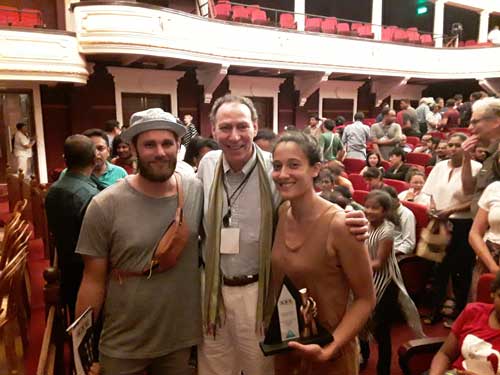
Ronald Rand with Farah Deen and Valentin Alfery at the Colombo International Theatre Festival in Sir Lanka, 2019
I first asked: What was their greatest need to create Hungry Sharks in 2011?
Valentin replied, “At first, there was the impulse to create our own visions and versions of dance within the artworld. As it is hard to “read” or “receive” contemporary dance and its concepts without being familiar with it, we felt that the movement language from the world of urban dance could function as an bridge to an audience that isn’t used to watch dance in theatre.”
Are both of your backgrounds in dance? Did you grow up dancing and study dance and when did you decide that dance was your calling?
Valentin: “ I have a background in sports and judo and got introduced and immediately hooked to urban dance when I was about twenty years old. Soon, after my first years of teaching himself, I started working as a dancer and eventually became a choreographer.”
Dušana: “Originally I was a photographer and contribute though translating concepts and principles from the world of creative images to the artistic output of Hungry Sharks. I hold a Masters’ degree in media and communication studies, and I was born with a strong personality, which makes me the perfect production manager for the company.”
How do you choose the dancers you want to work with?
Valentin replied: “One of our goals is to strengthen the Austrian Hip-Hop scene. We mostly choose dancers from Austria who share an interest in deepening urban dance choreography and dance within the theatrical context. The three major qualities we need for a long term connection with a dancer is to feel the possibility that we’ll grow together artistically, the ability to be organized and, since we spend a lot of time together with Hungry Sharks – to be on an equal and harmonious social level.”
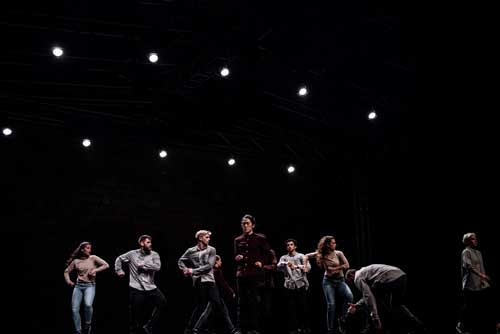
Hungry Sharks performing at the Dance & Nonverbal Theatre Festival, (photo: © Jelena Jankovic Photography)
I told them experiencing “the sky above, the mud below” was a most memorable experience at the Colombo International Theatre Festival, and asked what the rehearsal process was like? How did they decide with Farah Deen what ‘bridges’ were necessary to bring together Deen’s personal experiences which are shown in the piece?
Valentin began: “The impulse for the artistic process of “the Sky above, the Mud below” was a pragmatic thought, first and foremost. After creating and touring with twelve dancers on stage in the Hungry Sharks piece of 2016, “Hidden in Plain Sight,” we felt overwhelmed as leaders of the company. Our capacities of time and energy were exhausted.”
“The next logical step was to channel our artistic drive into a more compact format and create a solo-piece. Playing around with topics we focused on femininity, the human body and religion and decided to use elements of Farah’s personal story as a point of reference.
Valentin added: “During preparation talks, we collected experiences from her and tried out selected dance concepts, choreographic material from me. In the rehearsal process, we used these starting points to improvise, to create, transform and arrive at a dance piece that transports generally applicable values, can be objectively viewed and speaks to any public audience, that doesn’t have to know Farah personally.”
I asked about the powerful ending to the piece when a large drapery comes down around Deen?
Valentin continued: “The transformation of the curtain from the ‘papyrus of Leonardo da Vinci to the ‘veil of Mother Mary,’ came when we had the possibility to rehearse in a small theater. We were exploring quickly made-up possibilities, such as a fabric hanging from the ceiling or dancing on a carpet in the lounge of the theatre.”
“To have the curtain – that resembles a connection between ‘sky and mud’ – ripped off the ceiling was a combination of a lucky tryout-idea in the final preparations, two days before the premiere, with a 10 meter long fabric, and the unending creativity of our stage technician, Jasper Diekamp. It worked on the first try and we were happy to keep it as one of the strongest images in the piece.”
I asked about their upcoming plans and how they’re both coping with the current crisis?
Valentin told us: “Leading a dance company is a never-ending re-adjustment of the balance between a lot of aspects. The more the company evolves and grows, the more it takes hold of the people involved and the more things need to be thought of.”
“The lost opportunities and shows during the crisis are giving room for two things to appear. At first we embraced the stillness to digest and review our way so far. On the second hand, we have time to re-think and re-create our visions and goals with Hungry Sharks.”
Dušana continued: “We’re planning how to shape and formulate our artistic and social visions in the near future. One recent project is called ‘Young Sharks’ – a platform for emerging urban dancers to gather experience within the professional working field of dance on a theatre stage.”
I asked about their newest piece, “Zeitgeist” which takes place under water, how they came up with the concept and how the dancers learned to dance under water?
Valentin told us: “The idea for “Zeitgeist” was born when we saw night-divers in an underwater cave in Mexico flashing under water lamps through the dark water. The wish to work with this kind of aesthetic approach took several years of applying and failing before we could receive the funding we needed.”
“When we found a pool in Vienna that had glass windows for an audience to look through, we started with a two-day tryout period, to see if it was do-able. Later, we took Apnoe (cessation of breathing) diving lessons with the cast, to test ourselves to have a good capacity to stay and dance underwater.”
“The rehearsals took place in a public pool, directing and choreographing on the floor beneath the water with all the dancers/swimmers. We were also able to film each rehearsal to review the material. The final piece is forty-five minutes long and became the most exhausting production of Hungry Sharks so far. It was a true rollercoaster and it’s very exciting of which we are proud of.”
Hungry Sharks was awarded a special award in 2015 for performing arts by the Federal Chancellor’s Office of Austria for their non-verbal dance piece, “#fomo – the fear of missing.” In 2019, Hungry Sharks received a Performing Arts Award from the government of Carinthia, Austria. For info: www.hungrysharks.at
