







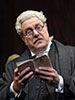


















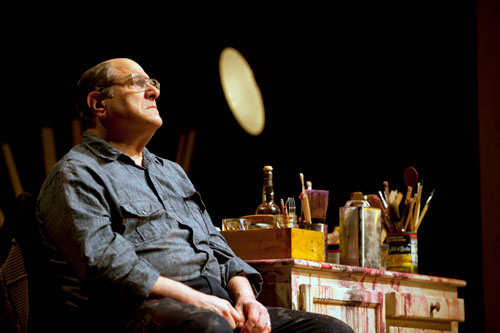
Bob Ari is Mark Rothko in “Red” (photo: T. Charles Erickson)
Bob Ari
Mr. Ari has appeared on Broadway in “The Constant Wife,” “Bells Are Ringing,” “Laughter on the 23rd Floor,” stand-by as Richard Nixon in “Frost/Nixon.” His Theater tours includes “Frost/Nixon,” “Guys and Dolls,” and “West Side Story.” Mr. Ari was born into the great tradition of Yiddish Theatre through his grandfather, producer Sol Dickstein. He began performing at the age of eight at The Anderson Theatre on Second Avenue, and became a Company Member of the American Conservatory Theatre under William Ball right after graduating from Carnegie-Mellon in Pittsburgh, performing in “Anthony and Cleopatra,” “The Tavern,” and was associated with The Loretto-Hilton Repertory of St. Louis and Artistic Director, Davey Marlin-Jones. Off Broadway appearances include in “Senior Moment,” “Witnessed by the World,” “It Must Be Him,” “The Late Christopher Bean,” “Die Mommie Die!,” “Jolson & Company,” “Picasso at the Lapin Agile” and “Baby Anger.” Mr. Ari’s stage work at many regional theaters include “Kiss Me Kate” (Shakespeare Theater, D.C.), “The Great Leap” (Denver Theatre Center /Seattle Rep), as Mark Rothko in “Red” (George St. Playhouse/Cleveland Playhouse), as Vincent Lombardi in “Lombardi “ (Cleveland Playhouse/Arizona Theatre Company), “My Name Is Asher Lev” (George St. Playhouse), as Andrew Wyke in “Sleuth” and “Witness For The Prosecution” (Olney Theatre Center), “Twelve Angry Men” and “Dracula” (Pioneer Theatre Company), as Tevye in “Fiddler on the Roof” (Galveston Outdoor Musicals), “The Front Page” (Long Wharf), “The Tale of the Allergist’s Wife” (Coconut Grove Playhouse,” “Big Love” and “Enemies, A Love Story” (Wilma Theatre), “Art” and “Hotel Suite” (Walnut Street Theatre), “Light Up The Sky,” (La Jolla Playhouse), “Twelfth Night” and “Awake And Sing” (Syracuse Stage), “Born Yesterday” and “The Price” (Delaware Theatre Company). He was a company member of Los Angeles’ Colony Studio Theatre for six years serving as an actor and director, and a company member of the Drama Dept. Mr. Ari’s film and television work includes “Two Lovers,” “Wanted,” “Kissing Jessica Stein,” “Music Of The Heart,” “Cradle Will Rock,” “Blind Date,” “The Good Wife,” “Ed,” “Dellaventura,” “Law and Order,” “L.A. Law,” “Cagney And Lacey,” “Diff’rent Strokes,” “Cheers,” “Soap” and “Law and Order SVU.”
In the midst of this crisis – How are you staying creative and in a forward-looking frame of mind?
We’re all putting our careers on hold, but I’ve actually been busy taping for a streaming TV, taping for an animated project, and auditioning on tape for TV shows and films.
It’s become such a trend; you expect TV and film casting directors to put you on tape but now even casting is done for the stage. They have you ‘self-tape.’ I guess, I’m old-fashioned. When I auditioned for “Caroline or Change” in London, I could understand it, but it’s being done a regular basis for theater casting. I just think it’s odd because I would expect directors would want to feel the physical presence of the actor.
I think for film and TV, there’s some validity; the whole thing about the camera ‘liking’ you; there are people who photograph well and those who don’t.
What do you love about acting that you must keep doing it.
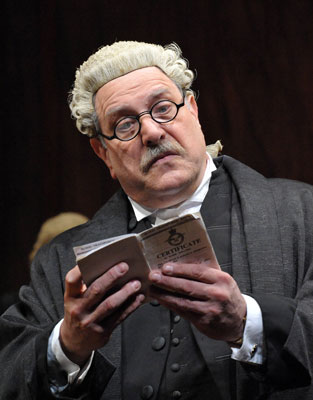
Bob Ari in “Witness for the Prosecution”
 My Mother’s father, my grandfather was Sol Dickstein, a producer, an impresario, and general manager at the Yiddish Art Theatre for Maurice Schwartz in lower Manhattan. In the company were actors like Paul Muni and Jacob Ben-Ami; Boris Aronson did the sets. The Theater was down on 12th Street across the street from the famous Cafe Royale, which was the Sardi's of the Yiddish Theatre.
It was also the first place where I performed. My grandfather managed the Anderson Theater on 2nd Avenue between 3rd and 4th Streets, and I grew up right around the corner; the theater was on the block so I was able to go in and see the shows As a young boy I would watch actors and actresses like Molly Picon, Menasha Skulnick perform. I didn't speak Yiddish, but I knew I was watching marvelous performers.
I had been a performing kid and would sing songs and perform in the living room for everyone when I was growing up. So, when I was eight years old, there was a Fundraiser for Israel; the headliner was Sammy Davis Jr., and the show began around 6pm, and around 6:30, my grandfather shoves me on the stage, and I sang “My Yiddishe Mamma.”
Is that when you knew you wanted to be an actor?
I said I wanted to be an actor up until junior high school, then I didn't know what I would be, I thought I’d be become a professional wrestler. Well, we did a production of “Guys and Dolls,” and I played the character, ‘Nicely-Nicely,’ and got an ovation for “Sit Down You're Rocking the Boat,” and it changed my mind.
When I entered high school, I knew I was going to be an actor and when I graduated they suggested I study it Carnegie Tech, that's what Carnegie Mellon was called at that time. So, I got my B.F.A. there and 20 four years later I went back to Carnegie Mellon to get my master’s degree.
They had a joint program with the Moscow Art Theater, you’d spend half a year in Pittsburgh and half a year in Moscow; it was amazing. We did Chekhov’s “Three Sisters,” and actually performed the second act for Hillary Clinton. The Clintons had come over for the May Day celebrations. and one night we were on a program she attended. Carnegie Mellon was the first university to have an exchange program with a Russian University. We were actually doing two plays, Steinbeck’s “The Grapes of Wrath,” which was directed by an American director, and every Saturday night we performed “The Three Sisters” which had been directed by Russian director. So, when they asked her she’d said she’d prefer to see an act from “Three Sisters,” so we performed for Hillary Clinton and Naina Yeltsin.
You were a Company Member of the American Conservatory Theatre under William Ball? What was William Ball like to work with – and what impact did it have upon your growth?
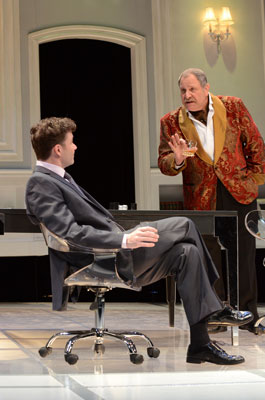
Bob Ari in “Sleuth” (photo: Stan Barouh)
 That was my first job out of college and it’s how I got my Equity card in 1971. Bill Barr was a genius. He was a very difficult man, but he was a genius; but he had really got ‘burned out’ from all those years at ACT. So, he had taken a year sabbatical, and I was there that season when he came back. He had set aside a room for all of us to ‘meditate.’
So, that season, Bill was going to direct “Caesar and Cleopatra” and “The Contractor” by David Storey, Alan Fletcher would direct “Anthony and Cleopatra” and “Paradise Lost, Ed Hastings did “The Tavern,” and at the end of the season, Ellis Rabb came in and directed “Sleuth” with Peter Donat.
My biggest part was as one of Anthony’s generals, but it turned out I also had the opening speech of the entire play which was very intimidating. I had the first speech at the beginning of the first readthrough, with all these incredible performers sitting around the table, including Peter Donat, Michael Learned, and on opening night, I came out and started the entire play off, so all I could do was I just ‘jump in the dead end.’
I also ended up playing the Sheriff in “The Tavern” and a union guy in “Paradise Lost,” and understudied Andrew Wyke in “Sleuth” at twenty-two years of age, and now all these years later, I ended up doing it.
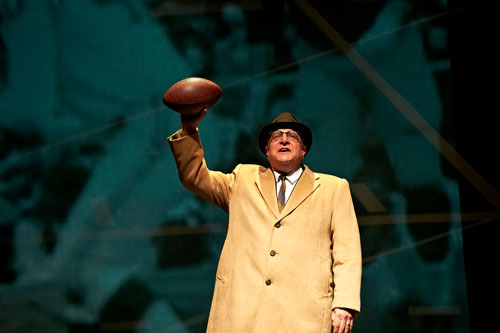
Bob Ari as legendary Green Bay Packers coach, Vince Lombardo in “Lombardi”
At Cleveland Playhouse you played painter Mark Rothko and Vince Lombardi. What did you draw upon from yourself to bring Mark Rothko alive in “Red?” and what centered you with finding Vincent Lombardi?
Rothko was no problem, yes, it was a challenging role but so much of his passion about art I share and when I went into it, I had just worked on “Frost Nixon” with Michael Grandage directing the production. So, I was able to call him since he had directed the original production of “Red,” and I asked him if he could give me any hints. He said, “He’s quite a monster, and you have to be not afraid to play a monster.” From that point on I understood him much more.
With Lombardi, I started off with the most extreme. Playing Lombardi called for a lot of yelling, so I had to deal with that physically, and I also found out he was a devout Catholic. So, I always carry the rosary in my pocket.
In the scene in the play, I found a moment. It was when I’m watching TV and I'm talking to the Reporter and I’m standing behind him, and I pulled out the rosary while I was talking to him. It meant something to him at that moment. I had a lot of fun playing that part.
What roles did you enjoy playing the most, and what were there similarities and differences between them?
I think Rothko and Tevye are my favorite roles. Yes, there’s a similarity in both of them, they’re sort of autonomous characters; Rothko in his studio and Tevye at home with his family. But the difference is Rothko is very arrogant outside of his studio and Tevye is jovial.
From that point once I started off with Rothko’s most extremes, it was Rothko’s contradictions and his passion for his art that I finally was attracted to and identified with.
How have playing these kinds of ‘larger than life’ characters changed you?
I find I’ve been able to express that part of myself onstage. I become more withdrawn as a person when I’m off stage, than as an actor when I’m on stage. A lot of actors are much more withdrawn in ‘real life.’
I remember my aunt who was a child actress in the Yiddish Theater, she was my other step sister, when she was told I was an actor, she said: “He’s not an actor,” thinking like all Yiddish actors have to ‘be on’ all the time. In other words, you’re weren’t an actor unless you were as big as you are on stage; it was because I wasn’t so outgoing. She couldn’t believe I was a very good actor.
Later when she saw me in a production of “Rosencrantz and Guildenstern,” she completely changed her mind. But I know offstage I am introverted, and my wife keeps working to bring me out. Its like playing roles that are a ‘wish fulfillment.’ I think there’s a part of me who wishes I was more like some of the personality of the characters I play.
I had the opportunity to play Richard Nixon in a film, and you played him in “Frost/Nixon.” What surprised you when you did your research about him, and eventually played him on stage?
I did a lot of research and found out about his home life. He was sort of pushed down in favor of his other brother, and then the other brother died because of an accident, and Nixon was suspected of possibly being responsible. A rock had been thrown at his brother’s head, and some thought Nixon may have done it. I think his sense of inferiority made him compensate for that his entire life.
What surprised me the most, and it was interesting and telling about his character. In a book I used during my research, they talked about Nixon forming his own fraternity at Whittier College to counter all the well-born, clean-cut blond ‘God-like’ students who were from better means that he had come from. So, he had formed his own fraternity, and of course, he was the president. When he was in office, I think his strong inferiority complex led to his wanting to be thought of as the greatest President ever.
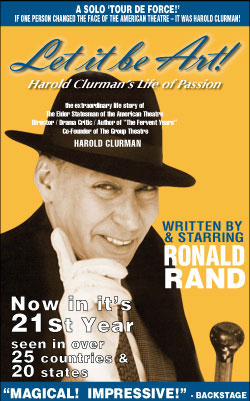
Both you and I have brought Harold Clurman to life on stage. Clurman had co-founded the greatest ensemble art theater we’ve had in this country, the famed Group Theatre of the 1930’s. What does the legacy of The Group Theatre mean to you?
They were the first company that brought a kind of realism to acting in their working together on Broadway, and in their theories as an artistic acting group; they were landmarks.
I consider Spencer Tracy and Marlon Brando the two greatest actors we’ve produced in America. Tracy and Brando changed the focus of the art of acting. Spencer invented film acting as we know it today, and The Group Theatre was the reason.
Brando had studied with Stella Adler who was in The Group Theatre, and he changed stage acting forever when he played Stanley Kowalski in “A Streetcar Named Desire.”
I wanted to go to Russia and study Stanislavsky because of The Group. Clurman and everyone of them were – they were my spiritual gurus. I never saw anything they did, but their spirit was in my mind. They came from the streets and, like Harold, they were educated.
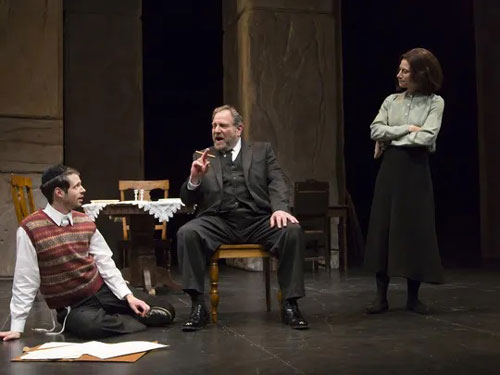
Bob Ari in “Asher Lev” (photo: T. Charles Erickson)
One of my grandfather was a butcher, and the other was a producer, so I have always tried to bring ‘the working man who was also sensitive’ into my work, which I think The Group Theatre embodied.
When you’ve worked on classic plays like “Born Yesterday,” “The Front Page” and “Twelve Angry Men,” among others – the only way they can come alive is to capture the playwright’s particular style and rhythm in their writing. How much of it comes from the director or between the interplay between the actors?
I think the style of a production comes from the director’s direction. He or she has to understand what the play is about. The rhythm in the scenes comes from the actors working together. When you’re acting in plays like Kaufman and Hart, Neil Simon or a play like “Born Yesterday,” you’ve got to understand the rhythm to make it work.
When you’re working on a good comedy, or a drama, that’s what comes from working together. When you get it right, you get it the lines right, and the moments happen perfectly, especially in a comedy you’ll get your laughs, if you have the sensibility you fall into the rhythm, and when you're working with the other actors who understand the same thing, it's like ‘basketball.
When I was working on Broadway in “Laughter on the 23rd Floor,” with Jerry Zaks as the director; that’s how he described it. He would always say: “You say the line and you pass the ball and you drive to the end,” just like in basketball.
I did an exercise once where you pick a line of Shakespeare, as you pick up a chair and you don’t put the chair down until you drive to the end of the particular phrase. When it’s that well-written, you go where it takes you. That’s what it takes.
Among those you’ve also played include Vincent Lombardi and more recently at the Olney in Sleuth as Andrew Wyke Do you have to like the person you’re playing and things they do?
No. I don’t think you have to like them, particularly but you have to understand. You certainly can’t play them like a villain. When I played Andrew Wyke in “Sleuth,” I looked at him as a twenty-two-year old; I certainly didn't understand him as well as I understood him when I recently played him.
With age comes an understanding of the insecurities inside a person. Within people lies a rare complexity. Sometimes they think they're the smartest people in the world but that’s part of their insecurities; you have to give them their motivations that they have inside.
I remember the very fine actor, Larry Luckinbill telling me that it’s ‘six times six’ – meaning that possibly after playing a character for at least six performances a week for six weeks – you begin to have a deeper understanding of who the person is you’re playing. How has it happened for you?
When I played Andrew Wyke in “Sleuth” most recently, there were times I think I had found more things about him. There is a lot of truth in that. I personally think it's at least two weeks and then another two weeks after you finish the production and you sit up in bed and you go up: “Now I understand how to play that moment!”
Sir John Gielgud said: “You never understand a Shakespeare part until you’ve played it at least three times.” I was fortunate to play three roles three times: Sir Toby Belch in “Twelfth Night,” Harry Brock in “Born Yesterday,” and Boris Kolenkhov in “You Can’t Take It with You” three times.
I really appreciate what Sir John Gielgud said. The last time I played Sir Toby Belch, I began to realize it was all about his getting older and losing his prowess and trying to compensate. As I’ve gotten older I've felt the same stuff. You understood it more you as you reach certain ‘road markers’ in your life.
With Harry in “Born Yesterday,” I was really just rolling along inside him. He was the toughest guy in the room, and I knew he had all these insecurities, and I finally found him the third time I played him, which was unstoppable. You just got to get ‘your laughs,’ when you play a character who's completely outrageous.
You are also a guitarist, teacher, and songwriter – and you continue to take acting classes?
Songwriting is much more personal; it’s a much more personal way to express myself. It led me to feel like a folk singer and took me it into Washington Square (in Greenwich Village in New York City), and I jammed with the other musicians there around the fountain. Now I’ve jumped into Bluegrass and I’ve become a huge Bluegrass fan.
Everything I do keeps me learning more about acting. I've also begun trying to write plays. I’m always involved with classes; I’ve been involved with The Actors Center, which was founded by Michael Miller and Lloyd Richards, and Earl Gister taught there for several years, among other excellent teachers. Recently I worked in a Michael Chekhov class conducted by Joanna Merlin; it sparked my imagination. I think that's what it's all about.
