























Taking the Business of Acting Online
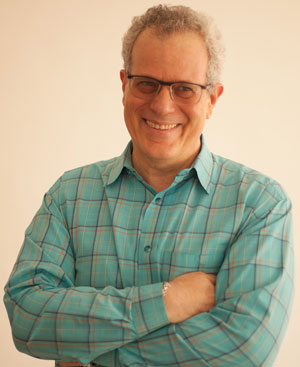 On Friday March 13th, (a fitting date it would seem), I was sitting in class with my students for what would be the last time in a long time. Some students didn’t come that day. Not a lot, but a few who were practicing social distancing, or felt sick. We were heading into ‘spring break’ the next week. I had been planning to go to Mexico with my family. We had tickets. We had an Airbnb. Everything was set.
But the night before I had decided to cancel the trip. As the updates on the virus came by the minute, I became worried I might get stranded far away from my students and staff when it came time to make a very hard decision.
That decision? To either take our classes online or postpone them indefinitely.
Earlier in the week I had attended a meeting with other small business leaders. As the threat of the virus grew, they began talking about how to pivot. I think to myself: “We can ’t pivot.” Certain businesses can pivot, but we can ’t. In-person contact is fundamental to our work. And if we can ’t do our work – if I can ’t coach actors and teach class – then I can ’t sustain my business.
My greatest fear was whether we would have to close our doors. I went to NYU later that same day to speak to Rosemary Quinn, my former boss and colleague of thirty years. I knew some universities were already committed to moving their classes online, including NYU.
On my way in, I was still thinking “There ’s no way this can work.” I thought about chemistry classes being taught online – classes where you would normally be doing experiments in a lab. How can this translate to online learning? It ’s just not the same. You can teach poetry online. But acting, voice, movement? No way.
When I got to NYU, Rosemary was the only one there. Students had left early, the staff was working from home, but she was still there. She was jolly and delighted to see me and gave me a big hug (well, an elbow bump actually).
And what she said next changed everything for me. “Look, we don ’t have a choice. We all pushed back but NYU said: “We ’re doing it, figure it out.” And then she said, with a big laugh.
“If there ’s anyone who can ‘figure it out, ’ it ’s us! Because improvisation is at our core.
And we have to figure out how to make this work and how to say yes to this.”
That began an interesting seed of a shift in me. For the next week, we wrestled with the
decision: “Are we going to do this? Is it really possible?”
Now, I’ve actually been coaching online for years. I’ve worked with Sam Rockwell for almost thirty years now, and occasionally we’ve had to coach over the phone. Sometimes he’s set and needs me to help calm his nerves. Or I ’m on vacation and he ’s got new pages of a script he needs to turn around fast. And we’ve made some exciting, engaging work with audio coaching.
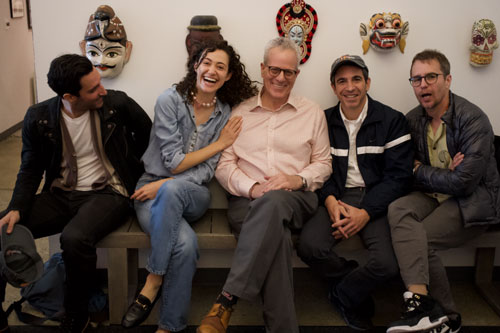
Terry Knickerbocker Studio alumni including Sam Rockwell
I worked with Emmy Rossum on nine seasons of “Shameless.” Except for the pilot, which we coached in person in New York, we coached every single episode over Skype. And all of that great work showed up on screen. Plus a surprise gathering between coaching sessions at the Studio with Sam Rockwell, Emmy Rossum, Chris Messina, Michael Godere between coaching sessions at the Studio.
I knew from experience that good acting and good coaching can happen virtually.
A day after my last day of class, I had an incredibly inspiring Zoom call with the National Alliance of Acting Teachers. Everyone there (mostly university teachers) were preparing to move their classes online.
One woman was telling the group how her husband is on the road for eight months a year, so they have nightly Facetime calls. She said: “And listen. There are these moments where I have the impulse to touch him. I reach towards the camera, and say: “Sweetheart, I ’m reaching for your face.”
She demonstrated, putting her hand up to the camera and speaking from that place in her soul. I felt like my own face was about to be touched. I started to realize that even in this digital, flat medium, the heart can still be present.
Finally, I had a call with our business advisor Caren Rubbino and she said: “If you can do it, do it. Because people are going to be stir-crazy. And the two things people will need right now are community and a sense of purpose and value. And if you offer this, they will feel that.”
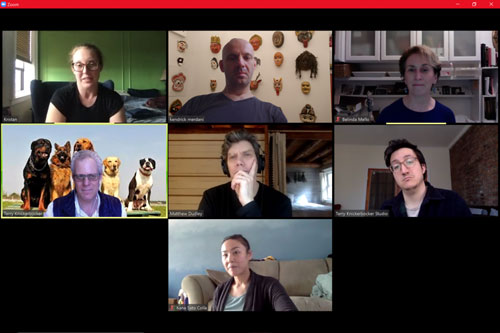
Terry Knickerbocker Studio Zoom Faculty meeting
So, we hunkered down and decided to do it. I spent my ‘spring break having dozens of meetings with the staff and faculty. And we put our heart and our soul into getting this off the ground. We bought Zoom licenses and considered every curriculum, every class. It wasn’t easy, but we got it done.
Caren had advised us to call every single student on the phone. So, we did. That was the smartest thing we did because it allowed us to be of a community, and connect with our students, to learn what their biggest fears and concerns were. Many of them had lost their jobs. Many of them were unsure about online learning, as I had been.
We had agonized, and ultimately decided not to lower tuition. We ’re a small business, and I believe the value of the work remains the same. It’s the Master Teachers, continuing to Master Teach! But we recognized the students ’ financial fear and concern and knew we would need to be flexible with our payment plans and ensure everyone understood we don ’t expect them to stay in class if they are unable to pay.
But to those who could, we encouraged them: “We want you in class. We think it ’s better to be in class than not, and we are dedicated to maintaining the value and integrity of the work.”
So, everything was in place. We were “all-in” on this choice. Then, Sunday March 22nd, the night before online classes were to begin, I was still so doubtful. I thought: “I don ’t think this can work. Our motto is ‘Training the Passionate Actor Committed to Excellence.’ If we can ’t deliver something that feels excellent, I don ’t want to be doing it.”
The next morning, I told my class, “We‘ll try it for a week. If it doesn’t feel right, we’ll put a pause on it and wait until we can resume in person.”
And I wasn’t truly convinced until my second classes – most of the first classes were spent checking in – seeing where everyone is “Zoom-ing” from, what their situation was, how they were feeling about class and the world, how they were coping.
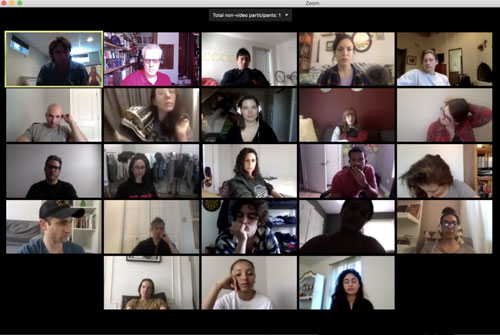
Terry Knickerbocker Studio online Zoom Class
At the end of one class, I did a repetition exercise with two wonderful students – Ian and John. As they got into the work, tears welled in their eyes, and I ’m seeing this close up with a level of detail and richness that I couldn’t see in the room.
Then I saw everyone work. And the work was quite good. And that revived my faith. Six weeks later, we ’re still doing it!
We‘ve been in the online classroom for almost two months now, taking it week by week. For the most part, everyone ’s all in. But it can be hard to get a sense of the group mood in this new platform.
We ’re trying to be flexible while also keeping our commitments to each other, and to the work, and everyone is doing the best work they can. That collective sense of commitment and community is helping everyone get through this challenge. It has definitely called for a lot of ingenuity…
We had to create some new conventions in the work to suit this platform. There are exercises where (let ’s call them Partner A and Partner B) Partner A would be outside in the hall and would knock on the door so that Partner B can let them in. So, now, we begin with everyone turning their video off except Partner B, who ’s “in the room.” Partner A knocks and Partner B can hear that through their screen.
Since Partner B can ’t physically open a door, they instead say: “Ok, I ’m opening the door.” And that cues Partner A to start their video so they ’re now in view and “in the scene.” It ’s funky, it ’s a bit strange, but if you commit to the convention and the scene and your circumstance, you can make it work. And that ’s what we’ve been doing. Quite successfully.
One of the hardest transitions has been when a script calls for contact. “How do I do a slap? How do I do a kiss?” We have a scene in second Year where one partner needs to massage the other ’s shoulders. That ’s obviously not going to be the same. That ’s really hard.
So, they both have to imagine that they ’re in that together. And if they re-create that physical sensation for themselves and respond to their partner “as if” they ’re touching, it ’s close. It just asks the actor to really focus and expand their imagination, which is important no matter what you ’re doing.
It ’s been a leap of faith to accept the conventions that we ’re working with, but once you get over that hump, it works.
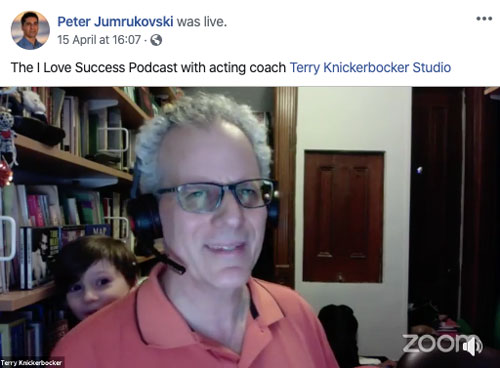
It ’s hard work. I believe I ’m doing the same teaching I would be in the room, but, boy, does it require a lot of extra energy. All of the faculty are working hard and offering incredible classes. And the students are doing good work. But I will admit it ’s draining. We have to take it week by week and continue to trust each other.
I think because of that trust, the value of the work comes back to us. That it’s a self-sustaining cycle and why, I think, this transition has been so successful for us.
Great stories of resilience are going to come out of this. This is training for resilience and who needs resilience more than actors? It ’s an unstable life. This is a great time to pay attention: What are people feeling? What are the stories that are going to come out of this? How do you make lemonade out of these very challenging lemons?
The great spiritual leader, Eckhart Tolle, quotes one of my favorite Shakespeare quotes: “For there is nothing either good or bad, but thinking makes it so.” (Hamlet, Act 2 Scene 2)
How you choose to see your situation is going to shape what you do.
So, if you see this as a terrible, restrictive problem, you ’re going to be depressed and angry and scared. And there are great reasons to be scared – great reasons to be discouraged. Some people don ’t have the right medical care; New Yorkers are dying every two minutes. It ’s a very scary time and here we are at the epicenter.
At the same time, you can also focus on “What do I want to do with this?” One great thing for me is extra time with my family. We used to go separate places every day, but now I ’m with them 24/7. Even when I ’m in class, I know they ’re there. And on my break, I come out, I give a hug, I get a hug, we have a snack together.
So, it’s important to focus on the opportunities available while also being honest. But if we can see this as an opportunity, I know we ’re going to get through this as a human race. And I hope we can get through it together, and stay healthy, so we can come back together soon.
We have always focused on community. I ’m happy to be the leader but I really can ’t do it without every one of the people involved. They ’re all stepping up. I ’m full of gratitude and pride for all of us. As Hillary Clinton said, “It takes a village.” And I have a pretty extraordinary village. • 2020
(Printed with the permission of Terry Knickerbocker.)
TERRY KNICKERBOCKER For the past thirty years in New York City, Terry Knickerbocker has acted, directed, coached, and produced art with some incredible people. In 2015 he founded Terry Knickerbocker Studio, a premier acting school, located in the heart of Industry City, Brooklyn. The Studio offers an affordable alternative to MFA programs, without sacrificing quality. By providing a conservatory setting, the world-class faculty rigorously trains the actor to succeed in a highly competitive industry. Mr. Knickerbocker is a graduate of The Experimental Theater Wing in the Drama Department at New York University. After graduating from NYU, he trained as an actor and a teacher with William Esper. He taught at The William Esper Studio for twenty-five years and continues as part of the core faculty at the Experimental Theatre Wing at NYU’s Tisch School of the Arts. Mr. Knickerbocker has also taught directing at Playwrights Horizons Theatre School and Yale University. His other teacher/mentors include Maggie Flanigan, Rina Yerushalmi, Steve Wangh, Terry Hayden, Nikos Psacharopoulos, Jackie Brookes, Mary Overlie, Ryszard Cieslak, Jerzy Grotowski, Pierre Lefèvre, Moshe Feldenkrais, Dr. Louis Ormont, and Dr. Harry Fogarty. Mr. Knickerbocker has coached actors on over three hundred films, television and theater projects, both on and off-Broadway and regionally. He also consulted with playwrights and screenwriters on their scripts. Among the actors he has worked with and trained include Sam Rockwell, Chris Messina, Boyd Holbrook, Natasha Lyonne, Leslie Bibb, Emily Rossum, Yul Vasquez, Jordana Spiro, Gillian Alexy, and Gretchen Mol. A past recipient of the Drama League of New York’s directing award/fellowship for emerging directors, Mr. Knickerbocker is also a former member of Circle Rep’s LAB. His directing credits include many new works as well as contemporary and classical plays including “Measure for Measure,” “Tartuffe,” “The Normal Heart,” “Candida,” “All My Sons,” and “In the Boom, Boom Room.” terryknickerbockerstudio.com/