















To Think the Thought
(from his essay, “The Dilated Body” in A Dictionary of Theatre Anthropology: The Secret Art of the Performer)
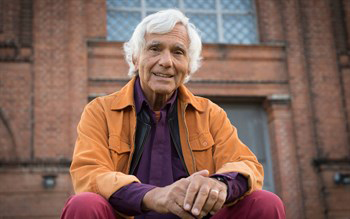
Eugenio Barba photo by Jena Thaysen
A physicist is walking along a beach and sees a child throwing stones into the sea, trying to make them skip. Each stone makes no more than one or two little skips. The child is perhaps five years old, and the adult, the physicist, remembers that he too, in his childhood bounced stones over the water. Indeed, he was very good at it. So, the adult shows the child how it is done. He throws the stones, one after another, showing the child how to hold them, at what angle to cast them, at what height over the surface of the water. All the stones that the adult throws skip many times, seven or eight even ten times.
‘Yes,’ the child then says, ‘they skip lots of times. But that isn't what I was trying to do. your stones are making round circles in the water. I want mine to make square circles.’
We know this story because the physicist told it to Einstein. Einstein reacted in an unexpected way when his young friend told him about meeting the child: ‘Give him my compliments and tell him not to worry if his stones don't make square circles in the water. The important thing is to think the thought.’
The questions that have given rise to many of the most important scientific discoveries are, when closely examined, as useless or gratuitous as that of the child busy throwing his stones in the water.
‘Why does incandescent iron become red?’, the fifty-year-old Max Planck asked himself; ‘What would a man see if he could ride a ray of light?’, Einstein asked himself. The fact these questions lead to great scientific discoveries should not blind us to the fact that they were leaps into the dark, rapid ideas which escaped one’s grasp.
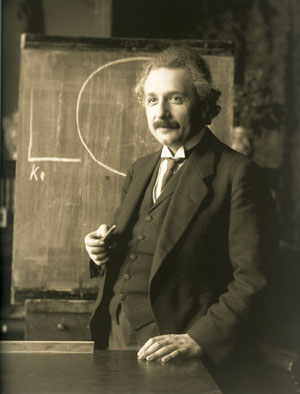
Albert Einstein during a lecture in Vienna in
1921 (photo: Ferdinand Schmutzer,
restored by Adam Cuerden
To think the thought implies waste, sudden transitions, abrupt turns, unexpected connections between previously unrelated levels in contexts, routes that intersect and vanish. It is as if different voices, different thoughts, each with its own logic, were simultaneously present and began to collaborate in an unplanned way, combining precision and fortuitousness, enjoyment of the game for its own sake intention towards a result.
This image of research is similar to that of a pack of hounds pursuing a prey that may or may not be ahead of them. The hounds run together, break up and disperse, get in the way of each other’s way, rush into thickets and ravines that severely test their abilities and energies and, when they emerge, they run in circles, discouraged at having lost the trail, are forced to turn back. But sometimes the dispersed hounds join up again and the reassembled pack tracks the prey down, discovers the idea.
It is not certain that the idea to be discovered will be there waiting for us, willing to be pursued and captured. It is a pure potentiality. We do not know what it's about nor what it might be used for. Sometimes it all comes to nothing. Other times, something new presents itself like a surprise that obliges us to become involved in an unexpected area.
Some scientists changed their field of research; some writers give up the story they've been working on and follow the new peripeteias of characters who have practically imposed themselves; in the midst of work on a production one becomes aware that in reality another production is leading us by the hand without yet knowing where it is leading us.
Sometimes one has the impression that it is not we who are ‘thinking the thought’, but that all we can do is silence the prejudices that prevent the thought from being thought.
At first, this is a painful experience. Before becoming a feeling of freedom, of an opening to new dimensions, it is a fight between what one has decided a priori, what one aspires to, and – on the other hand – the mind-in-life.
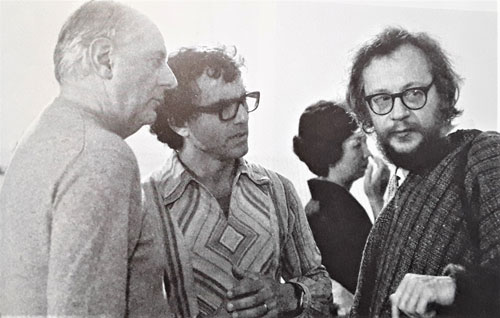
(L.-R.) Dario Fo, Eugenio Barba and Jerzy Grotowski at the Volterra ISTA, 1981
The danger a falling into chaos is obvious. When one succeeds in establishing this creative ‘pre-condition’, one can even have the feeling that one is possessed or that one is being taken out of oneself. But it's a feeling that remains anchored to the terra firma of craftsmanship, of one’s own trade.
When Eisenstein sat down at his moviola, he succeeded in creating a condition for his work in which it was material itself, and not results that have been previously decided upon, that dictated its own unexpected logic.
He – who had worked out his film frame by frame, who had worked out his film frame by framework compose it in his designs forever doing it so on the set – succeeded in sitting down in total ignorance in front of the material that he himself had created. The programming that had guided him up to that moment was now of no more use and he spoke to the ‘ecstasy of montage’.
To ‘think the thought’, the ‘mind-in-life’, the ‘ecstasy of montage’… these expressions all refer in a figurative way to the same kind of experience various fragments, various images, various thoughts are not connected to a precise direction or according to the logic of a clear plan but belong together because of ‘consanguinity’.
What does consanguinity mean in this context? That the various fragments, images, ideas alive in the context in which we have brought them to life, reveal their own autonomy, establish new relationships, and connect together on the basis of the logic that does not obey the logic used when we imagined or sought after them. It is as if hidden blood-ties activate possibilities other than those which we think are useful and justified.
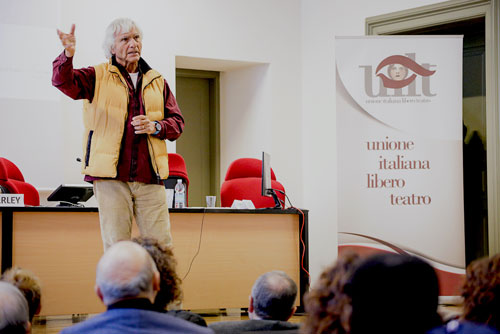
Eugenio Barba at the UILT assembly in Trento, 2017 (photo: Hegelus, by Davide Curatolo)
In the creative process, the materials with which we work at both a utilitarian life and a second life. The first, left to itself, leads to clarity without profundity. The second risks leading us into chaos because of its uncontrolled power.
But it is the dialectic between these two lives, between mechanical order and disorder, which leads us towards the what the Chinese called li, a symmetrical an unforeseeable order that characterizes organic life. • 2005
(Excerpt from an essay, “The Dilated Body” by Eugenio Barba in A Dictionary of Theatre Anthropology: The Secret Art of the Performer)by Eugenio Barba and Nicola Savarese. Permission to be reprinted by Eugenio Barba.)
EUGENIO BARBA — Director, theorist & founder of Odin Teatret in Denmark, Mr. Barba was Jerzy Grotowski’s assistant for 3 years, and wrote the first book about him. He has directed over seventy productions. He founded ISTA – International School of Theatre Anthropology, and has written several books including: Beyond The Floating Islands; Land of Ashes and Diamonds: My Apprenticeship in Poland with 26 Letters from Jerzy Grotowski to Eugenio Barba; Theatre: Solitude, Craft, Revolt; On Dramaturgy and Directing: Burning the House; and A Dictionary of Theatre Anthropology with Nicola Savarese. He has received numerous international awards and honorary doctorates.
