



















The Soul of the American Actor meets Mary Overlie: Original Dance Anarchist and Post-Modern Evangelist: A Tribute to Mary Overlie 1946-2020
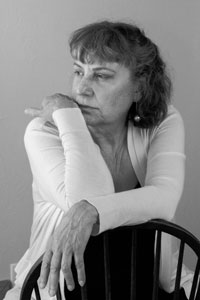 I met Mary Overlie in 1976 when we both awoke, about twenty feet apart, in our sleeping bags on the floor of Cynthia Hedstrom and Terry O’Reilly’s loft on the Bowery.
She had arrived mysteriously from a very distant point, from far away, in the middle of the night, and I had been encamped on that floor for months – waiting.
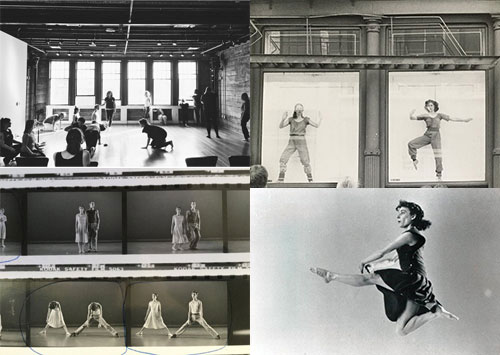
I studied with her and other company members of ‘The Natural History of the American Dancer’ (Lesser Known Species), joined her company for her first group choreography in the windows of The Holly Solomon Gallery on West Broadway, married Mary in 1979, divorced in 1987, and danced through life, along beside her, sometimes close, sometimes in middle distance, and sometimes far away, until her passing on June 5th of 2020.
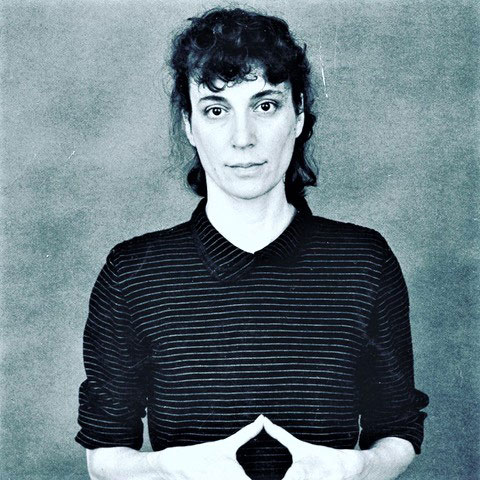
Mary Overlie
Since our first encounter, I continuously learned from her about dance, acting, non-acting, teaching, and about art that deftly merged heaven and earth. She had a rapier mind, otherworldly body, and a kind of fearlessness that could only come from certainty.
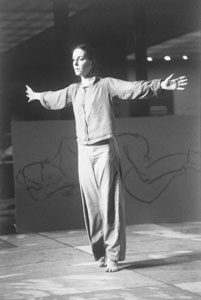
She was awake, very awake. Her choreography and her presence as a performer left the unmistakable impression that dance was not about movement primarily, or the athletic capacities of the body, or in any way about body separated from mind.
In short, her subject was consciousness. She was very clear from an early age about what she was doing when she performed, what her intentions were, and what she was intending the audience’s experience to be.
Her own choreography, particularly her solo work, operated somewhat like a “transmission” as that term is used in eastern spiritual traditions. People who experienced her dancing were not only mesmerized but also often adopted Mary as a lifelong muse.
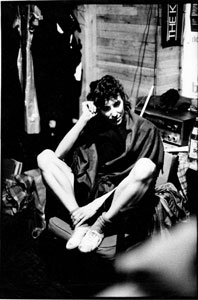 Here are first person observations by two prominent writers on dance of Mary’s early work:
Wendy Perron’s article: “Followable Dancing,” in the SOHO Weekly News, March 4th, 1976 – a review of Mary Overlie’s “Small Dance” at the Whitney Museum:
“In the program notes, Overlie calls the piece: “a three-way conversation between the body of the dancer, the mind of the dancer, and the audience.”
“On entering the space, Mary Overlie had an intentness that immediately brought a rowdy audience to a stunned silence. The poignant blend of authority and vulnerability in her face and the look of her beige-covered body will stay with me for some time.”
“Stillness was drawn out until it finally burst into motion. The flurry of motion was not really a contrast to the stillness because, like the yin-yang symbol, her motion had stillness within it and her stillness had motion.”
“Because she has this idea, and because she has an excellent sense of composition (where she’s coming from and where she’s going), the dancing was followable in a way that I found enormously satisfying. The kind of followable that good fiction has, or beautiful music, or a stimulating conversation – it makes me want to know, makes me care what the next word, the next note will be.”
Sally R. Sommer writing in “The Village Voice” in 1978, in an article entitled ‘Mary Overlie: Enigmatic Witness,’ described Mary’s performances in this way:
“She has a curious way of splitting concentration, of presenting herself.”
“As she dances she watches what she does, rather like an unruffled nonjudgmental witness.”
“The intensity [of the movement] is tempered because it rebounds against her own quiet observation.”
“Overlie is investigating performance presence in her work, that elusive quality everyone instantly recognizes, and no one defines well. Because she does not use narrative or character or tasks – nor is she interested in personality – what remains is the investigation of self through a distillation of personal images expressed in movement.”
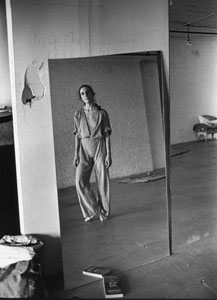 “Holding a personal score of images in her mind, sometimes emotional, sometimes spatial and these images cause the movement to bubble up…”
From these observations, it starts to become clear that the subsequent formulation of The Viewpoints, the performance and composition technique Mary bequeathed the world, was based on her own process of performing and making performance. The Viewpoints were a deconstruction of her own experience.
Mary Overlie’s “life in art” is the story of her thought – her own rather virtuosic consciousness – rippling out into wider and wider fields, wider and wider influence. This was accomplished without the usual trappings of ambition, territoriality, branding or actually even proclaiming ownership.
Mary fled from all of those things recognizing them each in their turn as horrific obstacles and destroyers of the essence of what she had to contribute.
The lasting work that she offered the world was The Viewpoints. The work has largely, within the mainstream theater world, been mis-attributed to the director Anne Bogart, a younger peer but also a student of Mary’s.
The Viewpoints were conceived by Mary as a way to deconstruct the act of performing and the products that activity produces.
As technique, The Viewpoints map the inner process of the performer whether actor or dancer or an amalgam, and simultaneously articulates the compositional field that one perceives when watching performance. Among the many profound ramifications of this work is a re-definition of performing as an activity of simultaneously composing and being.
The trajectory of The Viewpoints, from a formulation in Mary’s mind, through sharing the work with generations of students at New York University’s Experimental Theater Wing (ETW), to the self-publishing of her book, Standing in Space: The Six Viewpoints Theory & Practice in 2017, was an arduous one.
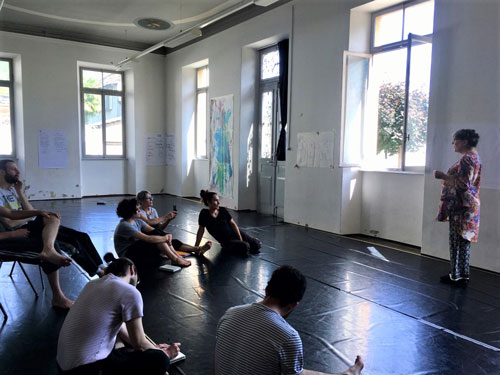
Mary Overlie teaching her Workshop, Accademia Teatro Dimitri, Switzerland, May 2018
At this moment there is hardly a theater program in the U.S. which does not include Mary’s Viewpoints as an essential part of training. The work spread far beyond the U.S. and is an important part of the global conversation in the field of performance. Misattribution has continued but Mary’s presence has begun to re-emerge thanks to the completion of her book, after twenty some years of writing, and her own rigorous touring in the past several years.
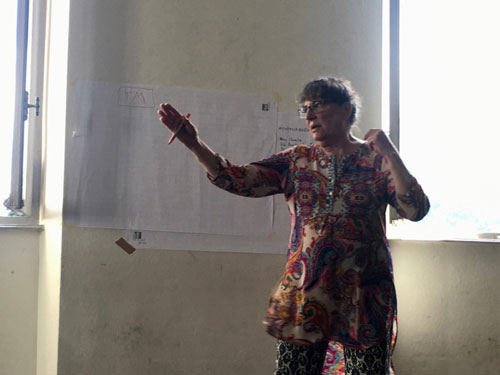
Mary Overlie teaching her Workshop, Accademia Teatro Dimitri, Switzerland, May 2018
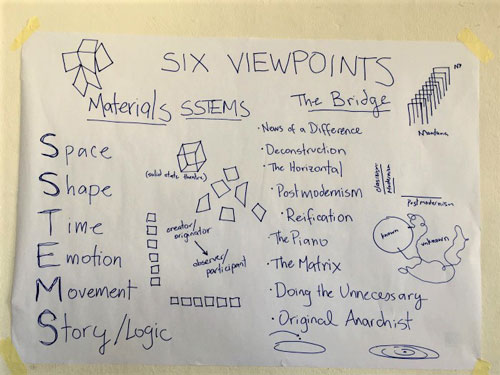
Chart used at Mary Overlie Workshop, Accademia Teatro Dimitri, Switzerland, May 2018
Her most recent workshop was in January of 2020, a ten-day intensive at The Shanghai Theater Academy(STA). The Shanghai Theater Academy had assembled eighty teachers and artists from all over China for these master classes. This followed several years of support from an array of independent European artists, longtime colleagues Ismael Ivo and Karl Regensburger at Vienna’s International Tanz Wochen, independent companies (specifically Vertico/Madrid), and universities which included repeated invitations to Rose Bruford College’s Summer Master Class Series. This in addition to widespread interest in her book, the thousands of her students who are teaching and making art, and several prominent directors and educators who credit Mary’s influence has raised her profile as not only the originator but the primary disseminator of The Viewpoints.
Contemporary directors and educators who consistently credit her influence are Anne Bogart and Moises Kaufman, Kevin Kuhlke and many others. This is a bookend to the directors of another generation, most prominently Lee Breuer and JoAnne Akalaitis, who also treated Mary earlier in her career as a muse, working with her as a choreographer on a number of productions.
Upon arriving in the first days of existence of New York University’s Experimental Theater Wing (ETW) by invitation of the programs founder, Ron Argelander, we found the “soul of the American actor” up for grabs. The young souls who were in the theater training programs at NYU were being buffeted by various religious beliefs about the soul of the actor, the sources of the actor, the identity of the actor, the function of the actor, and ultimately the means of the actor.
Built on the ashes of the original NYU MFA Theater program which had already become legend because of its famous encounter with Jerzy Grotowski – a first encounter for American theater artists on U.S. soil – ETW sort of snuck in like a weed in a somewhat out of control, raucous garden.
As artists picked up off the street, so to speak, with no academic credentials of any kind, we were advised to keep our heads down by Ron Argelander, the Founding Director of ETW. While he guarded the door, disguised as a legitimate academic with a full-time faculty position and a near Ph. D., we were free to continue to pursue our agenda as artists.
The nature of that agenda was experimental. We experimented endlessly with at first a single cohort of students. This took the form of probing the capacities of human expression.
Rather than teaching from form, we taught direct tools of research into what was physically, vocally, emotionally possible. Our students were our co-conspirators in this search. We treated them much like a company and ourselves a bit like directors or choreographers, often “teaching” somewhat indirectly by not showing, or telling students what to do, but rather by offering prompts, or directives that would put their bodies and minds into play.
We had a question, and we offered the question, “what will happen if you work with this idea/directive, do this task etc.? What will happen if you let space move you? What will your body do? What kind of sound will emerge? What kind of emotional journey does that evoke? What kind of image worlds does this create?”
This pedagogy based on questions and not answers was best served, and perhaps could only be served, by a process of deconstruction. Rather than assuming that acting is this, or dancing is that and teaching to various fixed hierarchies of acting/dancing, performing, we were obliged to investigate the constructs themselves. In what can only be described as a deeply intuitive process, Ron Argelander hired Mary Overlie as the first faculty member of ETW.
He did this after watching Mary’s piece, “Glassed Imagination,” performed in the 3’ x 5’ windows of Holly Solomon’s Gallery on West Broadway. He had previously been bringing in members of companies from the group theaters primarily from The Open Theater, The Ridiculous Theater, The Ontological Hysterical, Iowa Theater Lab, Mabou Mines, The Performance Group, who would teach the processes by which the companies made their work. This did not constitute a training but was a sampling for students enrolled in Argelander’s academic class on the avant-garde.
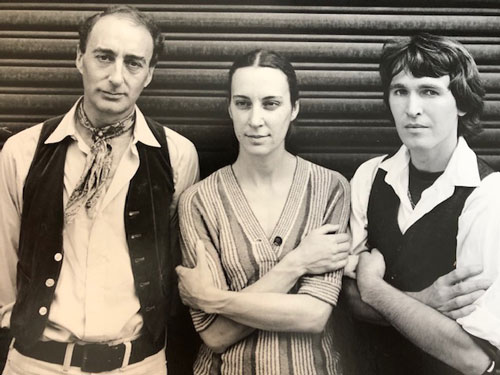
L.to R. David Warrilow, Mary Overlie, Wendell Beavers
Mary spent her first winter teaching in a raw loft space over The Bottom Line on the corner of Mercer and West 4th street. What she found herself teaching was The Viewpoints, a meticulous, quite full-blown pedagogy, never articulated or taught before. This was the ultimate deconstruction technique.
Deconstruction in this case was not only conceptual but was accomplished by physical investigation of the deconstructed elements. These elements of a deconstructed theater were derived by Mary to be space, time, shape, movement, story and emotion. The “training” was a process initiated by offering definitions of each Viewpoint as a way for the students to engage directly with each element.
From this were derived many improvisational prompts to guide students into a deeper physical investigation of each element. The Viewpoints were subsequently taught to each cohort entering ETW for the next forty-three years. It is currently being taught in the program by Mary’s students, graduates who continued to work with her diligently after graduation.
So, The Viewpoints in all of their dimensions arose from Mary’s own embodied clarity of vision and experience of perceiving and responding as the basis of making and sharing art. Mary’s effect on actors was also profound and life changing.
In a conversation many years ago, with Mabou Mines founding member Ruth Maleczech about acting, Ruth mentioned in an off-hand way that Mary was one of the greatest actors she had ever seen. Her answer to how that could be was succinct:
“When Mary stands still, or moves, although there doesn’t seem to be a difference, she is ‘acting’ with her body. I am always reading and experiencing all of the information. She is telling me something, and it is completely followable, like a text. I don’t think of it as dancing, she is “acting” with her body.”
Mary worked extensively with another Mabou Mines member and Beckett actor, David Warrilow, who put it this way, as quoted by Sommer in “The Village Voice” article cited above:
“He [Warrilow]compares this watchfulness to Grotowski’s idea of the ‘silent partner’ or ‘witnessing’ in the Buddhist sense, or the artists eye-movement filtered through consciousness.”
My first experiences with performing were in Mary’s first pieces which included “Glassed Imagination” and “Painter’s Dream,”which took place at The Kitchen Center in 1978. David Warrilow also performed in these pieces, and his work and the dialogue that went on between Mary and David constituted a complete de-construction, a discourse, of what an actor might be. In a sense this de-construction became David’s script.
This script included words, spoken aloud and silently, gestures derived from the moment before a gesture arrives, moments of pure presence objectified by intentional awareness. These included the blink of an eye, the touch of the jaw, the adjustment of the ‘pleat in pant,’ the sigh, the look of desperation and pain shifting unnoticed into pure exultation.
It was a script that demonstrated Mary’s concept of “horizontality” where all of the elements of one’s being, spatial, temporal, visual, kinesthetic, story (this is the story of a man who….), and emotion without object, were crafted into a repeatable score. It was a dizzying virtuosic flip of extreme subjectivity into extreme objectivity.
Between them, actor and “choreographer, they succeeded in making the personal universal, and also creating an invitation for the watcher to drop all defenses and feel the full dimension of what it is to be human. It was devastating to watch, and extremely devastating to perform beside and with.
I believe Mary’s view of acting could be summed up as manifesting consciousness without bias, and using this display as the pallet from which the actor composes each moment. She delivered this view to generations of young actors at ETW by sharing a naked process of deconstructing and reconstructing the Viewpoints as her pedagogy. It was challenging and life changing on the spot.
Mary was in a life and death struggle with cancer for the last two years of her life. The work she accomplished in these past two years was offered with such fierceness, devotion, clarity and overwhelming generosity that she, it appears, has guaranteed a further unfolding of her extraordinary vision. She was, and remains, a singular artist, with an enduring voice.
She has left multiple generations of artists with not only a deep imprint but also an indelible map for the future. This map is in the form of an irresistible invitation to more freedom, more fearlessness, more rapier clarity, more responsibility and finally more love of the world. In the last conversation I had with Mary, a few days before her passing, she began chuckling and said:
“The Viewpoints were originally taught in an era of developmental nascence of an art form. It was written for kindergarteners. It is now a grown-up plant and we have plants that have grown out of those. So maybe now…. We could begin……” • 2020
Written exclusively for “The Soul of the American Actor” Newspaper.
 Wendell Beavers A member of The Mary Overlie Dance Company from 1978-87, a co-founder with Overlie and an early Director of both Movement Research and New York University’s Experimental Theater Wing(ETW). Mr. Beavers was involved in applying the Viewpoints in collaboration with Overlie at NYU from 1978-2003. He was founder and Chair of Naropa University’s MFA Theater: Contemporary Performance program teaching there from 2004-16. He currently choreographs, directs, and performs with his company SomaticPerformer. sixviewpoints.com/maryoverlie
